
Fabrication & machine shops
Equipment and maintenance software for fabrication shops
A working shop with a delivery schedule needs three things the hobbyist tools do not provide: maintenance history that holds up in an audit, purchasing with a real approval trail, and certainty about who is qualified to run what.
What this kind of space actually runs into
Maintenance history has to be defensible
Every service action logs to the machine with who did it and when, and an audit log records every change to every record. When an insurer, an auditor, or a customer asks, the answer is a report rather than a recollection.
Operator qualification is a liability question
Access to a machine follows the credential automatically. Let a certification lapse and access pauses with it — the control is the same record as the proof.
Purchasing needs a paper trail, not a group chat
Requests move through an explicit workflow — requested, approved, ordered, received, shelved — each transition permissioned and logged, with supplier records and part numbers attached to the items they feed.
Tooling and consumables run out mid-job
Stock is tracked by location with reorder points, so endmills and bar stock get flagged before a job stalls rather than after. Adhesives, abrasives, and finishes carry usage guidance on the item, and an operator can ask what to use for a join and get an answer from what is actually on the shelf.
Where to start
The modules that carry the most weight here
Every plan includes the whole platform, but these are the ones this kind of space tends to lean on first.

Equipment & Fleet Maintenance
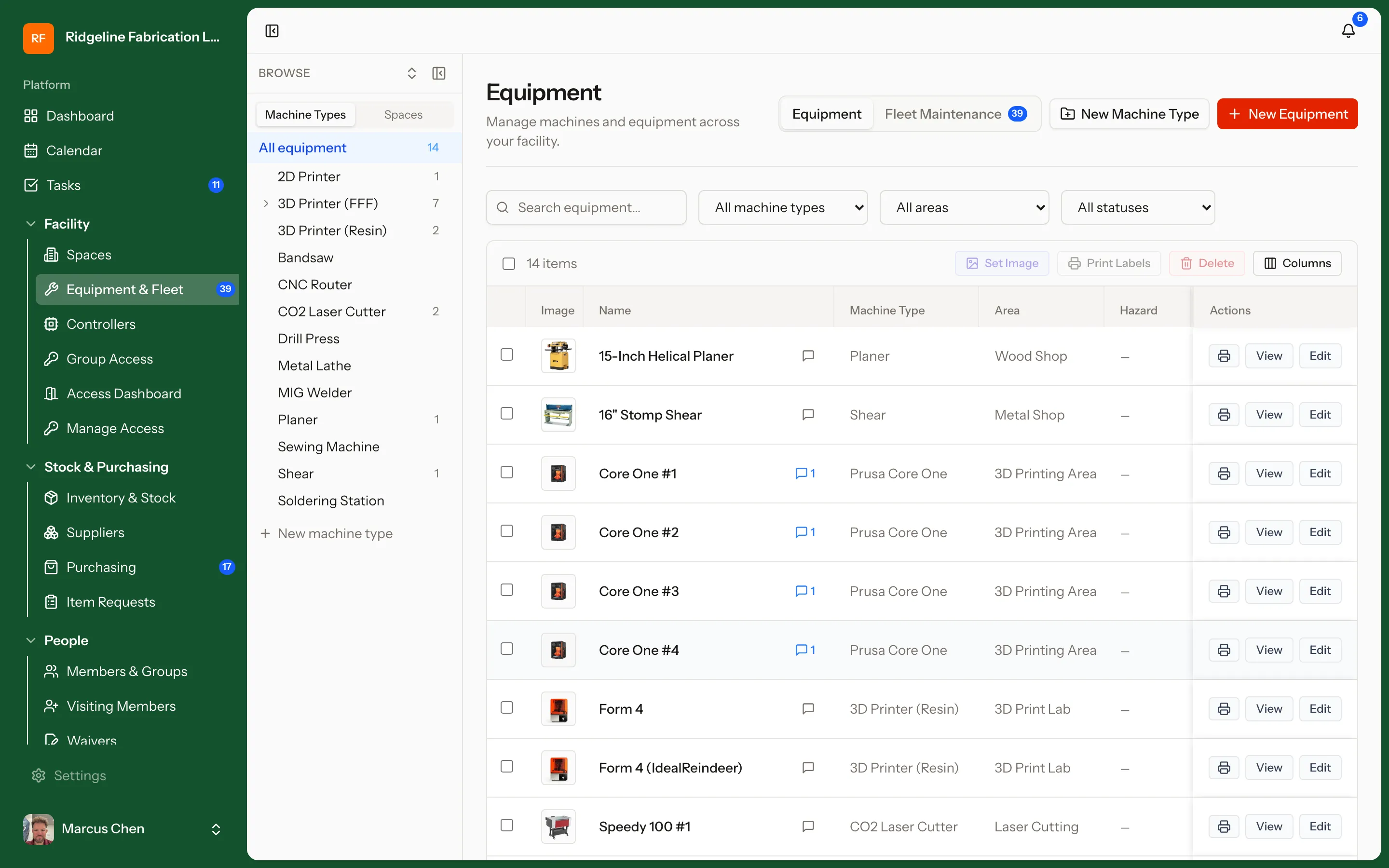
Track every asset on the floor — from a single laser cutter to a fleet of CNCs across buildings. Preventive maintenance schedules, service tickets, and downtime logs live on the machine record, so nothing depends on whoever happens to remember.

Approvals
A structured workflow for the things that need a yes. Members and staff file purchase requests, approvers work one queue, and every approve or reject is logged — so requesters always know where things stand.

Inventory
Consumables, stock, and materials tracked where they live, with usage guidance on the items themselves. Set reorder points so filament, bar stock, and safety supplies get flagged before they run out — and let members ask what to use for a job, answered only from what you actually stock.

Reporting & Dashboards
Live dashboards for daily operations: open tasks, maintenance coming due, the purchasing queue, and who is in the building right now. An audit log keeps a record of every change, and event signups export to CSV when you need the list.
Deliberately not academic-only
The same system runs a 2,000-student campus makerspace and a six-person shop with a delivery schedule. Modules you do not need can be switched off per workspace, so the interface reflects how you actually operate.
Run your space on process, not memory
Start free in minutes, or book a 30-minute walkthrough with real equipment, training flows, and reports — tuned to how your space actually operates.